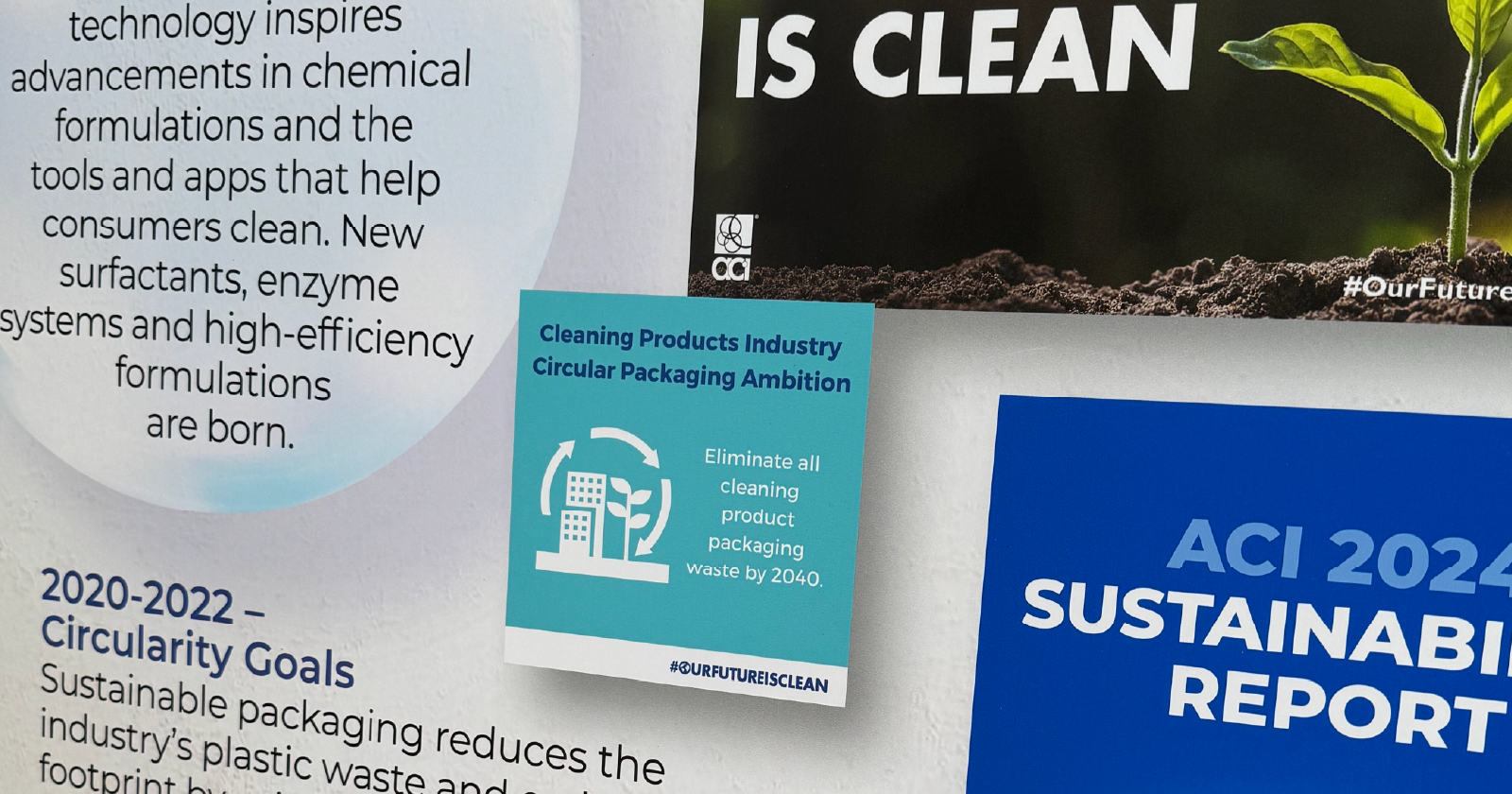
The American Cleaning Institute’s 2026 annual meeting made one point clear: circularity, regulation, and decarbonization are no longer side projects. They shape everyday decisions for formulation, packaging, manufacturing, and market strategy.
Innovation teams face tighter constraints and higher stakes. Missteps are costly. Using better data and modeling can help teams move faster, reduce rework, and avoid dead ends.
It’s clear science-based decision-making is now central to how teams and regulators evaluate risk, performance, and feasibility. But as expectations rise, so does the difficulty of assembling the data needed to support those decisions. That gap is creating a clear opening for Science-Based AI to help teams analyze complex technical landscapes faster and move forward with greater confidence.
1. Circular Packaging Is Moving From Pledges to Proof
Circular packaging efforts across the cleaning products industry are becoming more structured and measurable, supported by clearer design guidance rather than high-level pledges alone.
In recent years, companies have increased their focus on recyclability, source reduction, and the use of recycled content in packaging. These shifts signal real momentum, but also raise the bar for what comes next with new industry standards and regulations.
Over the past several years, companies have:
- Expanded commitments to fully recyclable packaging
- Increased efforts to reduce packaging at the source
- Accelerated adoption of recycled content
That is tangible progress, and it raises expectations. The easy wins are mostly gone. The next phase is more technical.
Key challenges now include:
- Cutting packaging through concentration and right-sized formats without hurting usability
- Switching to recycled, paper, or biodegradable materials while keeping barrier properties and compatibility intact
- Designing packaging that actually flows through real recycling systems, not packaging that only earns a symbol
- Making reuse and refill work at three levels at once: engineering, economics, and consumer behavior
At this point, trial-and-error starts to break down. A single packaging change can affect drop resistance, barrier performance, line efficiency, shelf life, labeling, and cost. Testing every option physically is slow and expensive. Our platform shows how modeling can compress development cycles and reduce over-testing. See how this works in practice in Optimizing Chemicals and Materials on the VIP Platform.
With modeling and data-informed design, teams can instead:
- Explore how material and structural changes affect performance and manufacturability before cutting tools
- Check designs against recyclability criteria, plastic footprint, and emerging policy requirements
- Build internal packaging patterns that capture what already works and apply those patterns across brands and regions
NobleAI’s Science-Based AI is already being used to solve similar problems in chemistries and materials. This reduces over-testing and compresses development cycles. Packaging reform is exactly that kind of multi-constraint problem.
2. Regulation Is Becoming More Dynamic. Foresight and Data Discipline Now Matter.
The industry outlook at ACI 2026 was clear: the regulatory environment for cleaning products is getting more complex, not less. Companies are navigating:
- A steady flow of new and evolving rules at federal, state, and international levels
- Growing attention to product life cycle impacts, from raw materials to use and disposal
- Increasing expectations for transparency around safety, environmental performance, and claims
For product, packaging, and operations teams, regulation is no longer something that appears only at the end of development. It is shaping:
- Which technologies and materials are worth investing in
- How aggressively companies can move into new markets and channels
- How portfolios need to evolve over the next 3–10 years
The pattern is familiar when teams are caught flat-footed:
- New rules land, and high-revenue product variants suddenly face constraints
- Reformulation or repackaging starts under intense time pressure
- Resources are spent reacting, rather than building a forward-looking strategy
The alternative is to treat the regulatory trendline as part of strategic planning. That means:
- Paying attention to emerging themes in policy debates (e.g., chemical classes of concern, extended producer responsibility, disclosure and labeling trends)
- Stress-testing portfolios against plausible future scenarios
- Identifying where today’s decisions could either create or avoid tomorrow’s compliance headaches
Science-Based AI supports this more proactive stance. Instead of waiting for a rule to be finalized and then scrambling, teams can:
- Explore “what if” scenarios: How would a tighter limit, a new disclosure rule, or a packaging standard affect the current portfolio?
- Use models to identify replacement options for higher-risk chemistries and formats early replacement chemicals ahead of regulation).
- Focus limited testing and data-gathering on the combinations of products and markets that are most exposed.
Regulation is becoming a design and portfolio strategy question as much as a legal one. The companies that fare best will treat regulatory signals as early inputs to innovation, backed by disciplined use of data and modeling, rather than as late-stage surprises. Our C&EN White Paper on Practical AI in R&D demonstrates how these approaches can accelerate decision-making even when available data is limited.
3. Decarbonization Is Now on the Same Clock as Product Decisions
ACI 2026 also highlighted momentum around carbon capture and storage and other modular decarbonization levers.
Standards such as SCS Carbon Assured are designed to turn actions like carbon capture into verified, reportable carbon reductions. This linkage matters. It connects plant-level decisions to corporate reporting and to the claims customers will see, rather than keeping decarbonization separate.
The timeline is tight:
- Organizations like ACI are working toward progress against 2030 climate targets
- Choices on decarbonization pathways, especially for energy- and carbon-intensive operations, need to be made soon
For innovation and operations teams, this translates into practical work:
- Pinpointing where carbon capture and other options such as fuel switching, process changes, and materials changes fit within specific value chains
- Weighing capital investment, operating cost, and verified carbon impact together rather than in isolation
- Folding decarbonization into formulation, packaging, and process design choices instead of treating it as a separate workstream
Here again, science-based modeling helps reduce risk:
- Simulating process and energy changes before money is spent on equipment
- Evaluating how lower-carbon inputs or utilities affect product footprints and margins
- Supporting carbon claims with transparent, data-based analysis that can withstand internal and external review
Decarbonization is no longer a sustainability slide. It is increasingly a product and manufacturing design constraint.
What This Means for Innovation Leaders
Across these themes, ACI 2026 pointed to the same underlying reality. Innovation teams are being asked to move faster while managing more technical, regulatory, and sustainability constraints at the same time.
Teams that stay ahead will:
- Treat circularity, regulation, and carbon as design inputs from the outset rather than last-minute checks
- Raise the bar on data quality and modeling early so uncertainty is reduced before tooling, trials, or capital requests
- Use virtual exploration to narrow the field of options before committing to lab work, pilots, and scale-up
This aligns with NobleAI’s core views. Product and process development are slower and more expensive than they need to be because teams rely heavily on testing to compensate for limited decision support. Models that reflect chemistry, materials behavior, and process physics can ease that burden on the lab.
How NobleAI Can Help Get Ahead of This
For cleaning brands turning ACI takeaways into near-term action, three practical moves stand out.
1. Inventory and prioritize
Identify packaging formats, regulated chemistries, and high-emission processes that sit at the intersection of circularity, regulatory risk, and carbon goals. Map those hotspots against internal business priorities so effort matches impact.
2. Start with the goal, not the dataset
Begin with the decision that needs to be made. For example, which alternative bottle designs for a flagship cleaner in Europe meet recyclability goals without new tooling?
Then:
- Define the minimum technical and business information needed to answer that question
- Use science-based models to show which additional data, if collected, would sharpen the answer
The goal is not to centralize all data or build a new LIMS. The goal is to activate just enough of the right data to support a concrete decision, then let the models point to the next most valuable measurements.
3. Design targeted experiments, not open-ended test plans
Use virtual exploration to narrow designs, materials, or process conditions to the few most likely to work. Then:
- Use physical testing and pilots to validate those candidates
- Reserve lab time for confirmation and refinement rather than discovery by brute force
NobleAI helps teams reduce early-stage development time while improving performance, cost, and sustainability. Connect with an expert to see how this works in practice for your industry and products. For a deeper look at how science-based decision-making accelerates product and process development across industries, explore our Diverse Use Cases Across Industries.
Frequently Asked Questions
The American Cleaning Institute’s 2026 annual meeting made one point clear: circularity, regulation, and decarbonization are no longer side projects. They shape everyday decisions for formulation, packaging, manufacturing, and market strategy.
Innovation teams face tighter constraints and higher stakes. Missteps are costly. Using better data and modeling can help teams move faster, reduce rework, and avoid dead ends.
It’s clear science-based decision-making is now central to how teams and regulators evaluate risk, performance, and feasibility. But as expectations rise, so does the difficulty of assembling the data needed to support those decisions. That gap is creating a clear opening for Science-Based AI to help teams analyze complex technical landscapes faster and move forward with greater confidence.
1. Circular Packaging Is Moving From Pledges to Proof
Circular packaging efforts across the cleaning products industry are becoming more structured and measurable, supported by clearer design guidance rather than high-level pledges alone.
In recent years, companies have increased their focus on recyclability, source reduction, and the use of recycled content in packaging. These shifts signal real momentum, but also raise the bar for what comes next with new industry standards and regulations.
Over the past several years, companies have:
- Expanded commitments to fully recyclable packaging
- Increased efforts to reduce packaging at the source
- Accelerated adoption of recycled content
That is tangible progress, and it raises expectations. The easy wins are mostly gone. The next phase is more technical.
Key challenges now include:
- Cutting packaging through concentration and right-sized formats without hurting usability
- Switching to recycled, paper, or biodegradable materials while keeping barrier properties and compatibility intact
- Designing packaging that actually flows through real recycling systems, not packaging that only earns a symbol
- Making reuse and refill work at three levels at once: engineering, economics, and consumer behavior
At this point, trial-and-error starts to break down. A single packaging change can affect drop resistance, barrier performance, line efficiency, shelf life, labeling, and cost. Testing every option physically is slow and expensive. Our platform shows how modeling can compress development cycles and reduce over-testing. See how this works in practice in Optimizing Chemicals and Materials on the VIP Platform.
With modeling and data-informed design, teams can instead:
- Explore how material and structural changes affect performance and manufacturability before cutting tools
- Check designs against recyclability criteria, plastic footprint, and emerging policy requirements
- Build internal packaging patterns that capture what already works and apply those patterns across brands and regions
NobleAI’s Science-Based AI is already being used to solve similar problems in chemistries and materials. This reduces over-testing and compresses development cycles. Packaging reform is exactly that kind of multi-constraint problem.
2. Regulation Is Becoming More Dynamic. Foresight and Data Discipline Now Matter.
The industry outlook at ACI 2026 was clear: the regulatory environment for cleaning products is getting more complex, not less. Companies are navigating:
- A steady flow of new and evolving rules at federal, state, and international levels
- Growing attention to product life cycle impacts, from raw materials to use and disposal
- Increasing expectations for transparency around safety, environmental performance, and claims
For product, packaging, and operations teams, regulation is no longer something that appears only at the end of development. It is shaping:
- Which technologies and materials are worth investing in
- How aggressively companies can move into new markets and channels
- How portfolios need to evolve over the next 3–10 years
The pattern is familiar when teams are caught flat-footed:
- New rules land, and high-revenue product variants suddenly face constraints
- Reformulation or repackaging starts under intense time pressure
- Resources are spent reacting, rather than building a forward-looking strategy
The alternative is to treat the regulatory trendline as part of strategic planning. That means:
- Paying attention to emerging themes in policy debates (e.g., chemical classes of concern, extended producer responsibility, disclosure and labeling trends)
- Stress-testing portfolios against plausible future scenarios
- Identifying where today’s decisions could either create or avoid tomorrow’s compliance headaches
Science-Based AI supports this more proactive stance. Instead of waiting for a rule to be finalized and then scrambling, teams can:
- Explore “what if” scenarios: How would a tighter limit, a new disclosure rule, or a packaging standard affect the current portfolio?
- Use models to identify replacement options for higher-risk chemistries and formats early replacement chemicals ahead of regulation).
- Focus limited testing and data-gathering on the combinations of products and markets that are most exposed.
Regulation is becoming a design and portfolio strategy question as much as a legal one. The companies that fare best will treat regulatory signals as early inputs to innovation, backed by disciplined use of data and modeling, rather than as late-stage surprises. Our C&EN White Paper on Practical AI in R&D demonstrates how these approaches can accelerate decision-making even when available data is limited.
3. Decarbonization Is Now on the Same Clock as Product Decisions
ACI 2026 also highlighted momentum around carbon capture and storage and other modular decarbonization levers.
Standards such as SCS Carbon Assured are designed to turn actions like carbon capture into verified, reportable carbon reductions. This linkage matters. It connects plant-level decisions to corporate reporting and to the claims customers will see, rather than keeping decarbonization separate.
The timeline is tight:
- Organizations like ACI are working toward progress against 2030 climate targets
- Choices on decarbonization pathways, especially for energy- and carbon-intensive operations, need to be made soon
For innovation and operations teams, this translates into practical work:
- Pinpointing where carbon capture and other options such as fuel switching, process changes, and materials changes fit within specific value chains
- Weighing capital investment, operating cost, and verified carbon impact together rather than in isolation
- Folding decarbonization into formulation, packaging, and process design choices instead of treating it as a separate workstream
Here again, science-based modeling helps reduce risk:
- Simulating process and energy changes before money is spent on equipment
- Evaluating how lower-carbon inputs or utilities affect product footprints and margins
- Supporting carbon claims with transparent, data-based analysis that can withstand internal and external review
Decarbonization is no longer a sustainability slide. It is increasingly a product and manufacturing design constraint.
What This Means for Innovation Leaders
Across these themes, ACI 2026 pointed to the same underlying reality. Innovation teams are being asked to move faster while managing more technical, regulatory, and sustainability constraints at the same time.
Teams that stay ahead will:
- Treat circularity, regulation, and carbon as design inputs from the outset rather than last-minute checks
- Raise the bar on data quality and modeling early so uncertainty is reduced before tooling, trials, or capital requests
- Use virtual exploration to narrow the field of options before committing to lab work, pilots, and scale-up
This aligns with NobleAI’s core views. Product and process development are slower and more expensive than they need to be because teams rely heavily on testing to compensate for limited decision support. Models that reflect chemistry, materials behavior, and process physics can ease that burden on the lab.
How NobleAI Can Help Get Ahead of This
For cleaning brands turning ACI takeaways into near-term action, three practical moves stand out.
1. Inventory and prioritize
Identify packaging formats, regulated chemistries, and high-emission processes that sit at the intersection of circularity, regulatory risk, and carbon goals. Map those hotspots against internal business priorities so effort matches impact.
2. Start with the goal, not the dataset
Begin with the decision that needs to be made. For example, which alternative bottle designs for a flagship cleaner in Europe meet recyclability goals without new tooling?
Then:
- Define the minimum technical and business information needed to answer that question
- Use science-based models to show which additional data, if collected, would sharpen the answer
The goal is not to centralize all data or build a new LIMS. The goal is to activate just enough of the right data to support a concrete decision, then let the models point to the next most valuable measurements.
3. Design targeted experiments, not open-ended test plans
Use virtual exploration to narrow designs, materials, or process conditions to the few most likely to work. Then:
- Use physical testing and pilots to validate those candidates
- Reserve lab time for confirmation and refinement rather than discovery by brute force
NobleAI helps teams reduce early-stage development time while improving performance, cost, and sustainability. Connect with an expert to see how this works in practice for your industry and products. For a deeper look at how science-based decision-making accelerates product and process development across industries, explore our Diverse Use Cases Across Industries.